


Investing in real estate in Dubai is becoming increasingly attractive for foreign investors. A key factor in decision-making is ROI – return on investment – and the average rental yields, which in Dubai are often higher than in many European cities. This guide will show you where and how to achieve the best rental yields and advise you on how to maximize your profit.
Dubai is a global magnet for expats, entrepreneurs, and tourists. Modern residential projects, high-quality infrastructure, and strong demand for rentals make the city an ideal place for investment.
The average gross rental yield in the United Arab Emirates is 4.87% (Q2 2025). Previously, in Q4 2024, the rental yield was 4.92%, according to Global Property Guide.
The average gross rental yield in Slovakia is 4.88% (Q2 2025). Previously, in Q2 2024, the rental yield was 5.29%, according to Global Property Guide.
This difference is due to a combination of factors: strong rental demand, low rental taxes, high tourism activity, and the flexibility of short-term rentals, which allows investors to optimize their profits.
Another way to achieve attractive returns is through off-plan projects in Dubai – investments in properties under construction, which often offer a lower initial price and the potential for higher appreciation once the project is completed.
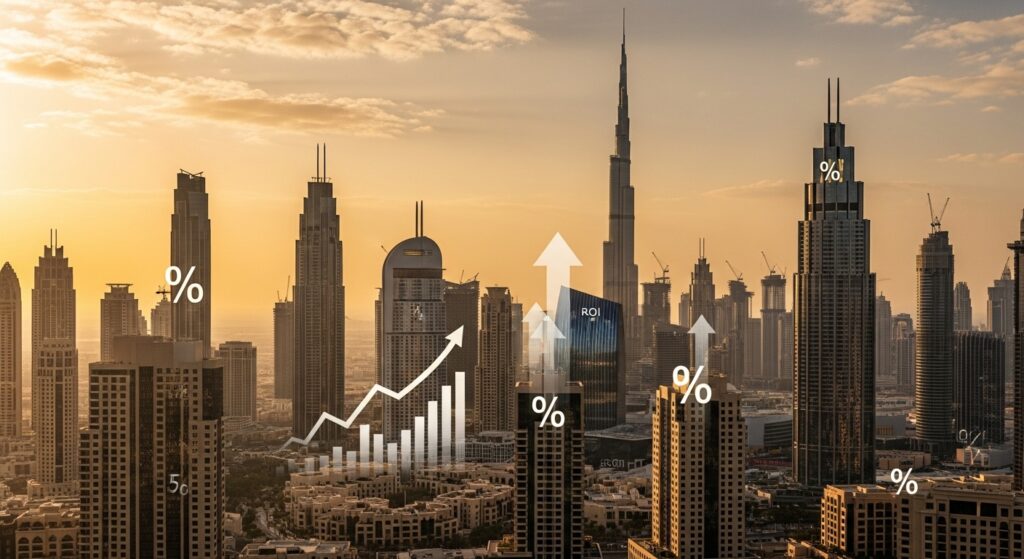
What ROI and Rental Yield Mean
ROI (Return on Investment) is an indicator that shows how much profit an investment generates compared to the costs involved. In real estate, it is mainly used when buying an apartment or house for rental purposes – an investor wants to know what percentage of annual income the property will earn.
Rental yield is calculated as the ratio of the annual rental income to the purchase price of the property (including all fees and costs). For example, if you buy an apartment for 200,000 € and receive 9,740 € per year from rent, your gross annual yield is 4.87%, which corresponds to the average gross rental yield in the United Arab Emirates.
It is important to distinguish between gross rental yield and net ROI. Gross yield only includes rental income, while net ROI also considers additional costs – such as management fees, maintenance, taxes, or periods when the property is vacant. Therefore, for an investor, it is more important to track net ROI, which provides a more realistic picture of the investment’s return.
For comparison:
- The average gross rental yield in the United Arab Emirates is 4.87% (Q2 2025), previously 4.92% (Q4 2024).
- The average gross rental yield in Slovakia is 4.88% (Q2 2025), previously 5.29% (Q2 2024).
This difference is caused by a combination of factors: strong rental demand, low rental taxes, high tourism activity, and the flexibility of short-term rentals, which allows investors to optimize profits.
Tip for investors: before purchasing, conduct detailed research on the location. Find out the average ROI in the area, compare it with other parts of the city, and include all costs associated with operating the property. In addition to the current yield, consider the potential for the property’s value to grow in the future.
Definition of ROI (Return on Investment)
ROI expresses in percentage how much profit an investment generates relative to its original cost. It is a key indicator for investors who want to assess the efficiency of their real estate investments.
Formula for calculating ROI:
ROI (%) = (Annual Net Rental Income / Property Price) × 100
Example:
- Property price: 250,000 €
- Annual net rental income: 20,000 €
- ROI = (20,000 / 250,000) × 100 = 8%
This indicator allows investors to compare different properties and determine which offers the best return relative to the invested amount.
How ROI is Calculated for Real Estate
When investing in real estate in Dubai, it is important to know how to calculate ROI, or return on investment, correctly. The calculation starts with all rental income from the property, which is the monthly rent multiplied by 12 months. From this total, all expenses related to the property, such as management fees, maintenance, or repairs, are subtracted.
The net annual profit is then divided by the property price, and the result is multiplied by 100 to obtain ROI as a percentage.
Example of ROI calculation in Dubai:
- Monthly rent: 2,000 €
- Annual income: 2,000 × 12 = 24,000 €
- Management and maintenance costs: 3,000 €
- Net annual profit: 24,000 – 3,000 = 21,000 €
- Property price: 300,000 €
- ROI = (21,000 / 300,000) × 100 = 7 %
This calculation helps investors clearly see the expected rental returns in Dubai and compare different properties to identify those with the best profit potential.
Factors Affecting ROI in Dubai
Rental yield in Dubai depends on several factors that can significantly influence the return on investment. One of the main factors is the location and attractiveness of the area. Apartments in popular districts, such as Dubai Marina, Downtown, or Jumeirah Village Circle, have higher demand, allowing for higher rental income and thus a higher ROI.
The type and size of the property also play an important role. Smaller apartments and studios often yield a higher percentage return compared to large luxury apartments, although the total monthly income may be lower.
Management and maintenance fees reduce net annual profit and, consequently, ROI. Higher service charges in luxury complexes can significantly affect overall investment returns.
Demand for short-term or long-term rentals is another key factor. Short-term rentals through platforms like Airbnb can generate higher monthly income but come with higher marketing and management costs. Long-term rentals offer stability and lower operating costs, but with slightly lower ROI.
Average Rental Yields in Dubai (2025)
Dubai is one of the most attractive real estate markets in the world, mainly due to the stable growth in rental demand. Investors focus primarily on ROI and average rental yields, which vary depending on location, property type, and lease duration. In 2025, the Dubai market offers competitive yields that rank among the above-average compared to other global metropolitan areas.
Dubai Marina – Expat Hotspot, High Demand
Dubai Marina has long been one of the most popular areas for foreign tenants and investors. It features numerous modern residential towers, luxury apartments with sea views, and a promenade filled with restaurants, cafes, and shops. The location is ideal for expats seeking a combination of urban and coastal lifestyle.
High and stable rental demand ensures attractive yields for investors. Demand is supported by excellent metro access, proximity to the beach, and a vibrant lifestyle.
Palm Jumeirah – Luxury, Short-Term Rentals (Airbnb)
Palm Jumeirah is an iconic location offering luxury villas, penthouses, and apartments right on the “palm” of Dubai. Most investors target the premium segment—foreign professionals, entrepreneurs, and tourists seeking short-term rentals via Airbnb and similar platforms.
Downtown – Business Hub, Higher Prices, Stable Rentals
Downtown Dubai is home to iconic landmarks such as Burj Khalifa and Dubai Mall. It serves as the city’s business and tourist hub, attracting high-paying tenants including managers, entrepreneurs, and expats working in the center.
Although apartment prices are among the highest in Dubai, stable rental demand provides security for investors. Average ROI ranges between 5-6 %. While lower than in more affordable areas, rentals are long-term stable and occupancy gaps are minimal. Downtown is suitable for investors who prioritize security and premium tenants over maximum yield.
Jumeirah Village Circle (JVC) – Highest ROI for Affordable Apartments
JVC is considered one of the most attractive areas for investors seeking high rental returns. The area offers more affordable apartments and smaller residential projects, making it popular among young families and the middle class.
The combination of low entry prices and growing housing demand creates high rental yield potential. The area is continuously developing, with new projects, schools, shops, and services increasing property values and making JVC appealing for investors seeking stable income and long-term capital growth.
Expo City and Dubai South – Growing Demand, New Projects
Expo City and the broader Dubai South area are new, rapidly developing parts of Dubai. Thanks to large-scale development projects, expanding infrastructure, and proximity to Al Maktoum Airport, rental demand is expected to grow quickly.
Investors can still find relatively affordable properties with high future appreciation potential. ROI is currently stable, with further growth expected alongside rising property values. This location is ideal for investors looking to enter at the start of a growth trend and benefit from Dubai’s long-term expansion southwards.
Comparison of ROI in Dubai and Europe
Rental yields vary significantly by region. While Dubai ranks among the destinations with the highest average ROI in the world, most European capitals have lower yields, often subject to higher taxation.
Dubai (7-9%) vs Bratislava/Prague (3-4%)
When investing in real estate, it is important to consider the return on investment across different regions. Dubai offers significantly higher rental yields compared to European capitals such as Bratislava or Prague.
Rental demand in Dubai is consistently strong. Areas like Dubai Marina, Jumeirah Village Circle, and Downtown Dubai are among the most sought-after by expats and tourists, providing investors with a steady income. Bratislava and Prague offer stable markets but with lower dynamics and slower growth in rental demand.
The tax environment also has a major impact on effective returns. Dubai is known for zero rental tax, allowing investors to maximize profits. In Bratislava and Prague, rental income is subject to income tax and often additional contributions, which reduces net returns on investment.
Tourism and short-term rental opportunities further increase Dubai’s attractiveness. The city attracts millions of tourists annually, enabling effective use of platforms for short-term rentals. Bratislava and Prague have stricter regulations on short-term rentals, resulting in lower yields.
Property price growth and overall market dynamics are another key factor. Dubai not only provides stable rental income but also the potential for long-term capital appreciation, whereas European cities offer stability but slower price growth, affecting overall investment returns.
Factors of Differences (Demand, Taxes, Tourism)
When comparing rental ROI between Dubai and European cities, three main factors need to be considered:
1. Rental Demand
Dubai is a global expat hub and a tourist destination, which ensures high and stable rental demand. Areas such as Dubai Marina, Jumeirah Village Circle, and Downtown Dubai are highly sought after, allowing investors to secure regular income and higher ROI. In Bratislava and Prague, demand is stable, but population growth and the number of foreign tenants are lower, so the average rental yield is lower.
2. Tax Environment
Dubai is known for having zero income tax on rental income, meaning investors receive net returns without deductions. In Europe, including Bratislava and Prague, rental income is subject to income tax and often social and health contributions, which significantly reduces net ROI and the overall efficiency of the investment.
3. Tourism and Short-Term Rentals
Strong tourism in Dubai allows for effective use of short-term rentals, significantly increasing potential returns. In Bratislava and Prague, while short-term rentals are possible, legislative restrictions and a smaller number of tourists result in lower income from this type of rental.
Factors Influencing Rental Yield
When investing in real estate in Dubai, it is important to understand which factors most significantly influence rental yield. Rental returns depend on several aspects that determine the profit an investor can expect. The main factors include location, property type, developer and building management quality, and demand for short-term or long-term rentals.
Location (City Center vs. New Districts)
Rental yield in Dubai is highly dependent on the property’s location.
- Central and Popular Areas: Dubai Marina, Downtown Dubai, and Jumeirah Village Circle are among the most sought-after locations for expats and tourists. High rental demand allows investors to charge higher rents and achieve a higher ROI. Additionally, these areas are well-connected with public transport, shops, restaurants, and services, which increases their attractiveness to tenants.
- New Districts: Areas outside the city center may offer lower property prices, reducing initial investment costs, but the return on investment tends to be lower. Often, infrastructure is less developed, and the distance from metro stations, beaches, or shopping areas can reduce demand and, consequently, potential rental income.
Investor Tip: When choosing a location, it is advisable to monitor property price growth and upcoming projects in the vicinity, as these can influence both demand and ROI.
Property Type (Studio, 1BR, Luxury Apartment)
Rental yield varies depending on the size and type of property:
- Studios and Smaller Apartments: These offer a higher percentage ROI because the purchase price is lower and demand for affordable housing is stable. Ideal for young professionals and singles.
- One- and Two-Bedroom Apartments: Provide a balanced combination of purchase price and rental income, suitable for families or couples. ROI is generally slightly lower than for studios, but tenant stability is higher.
- Luxury Apartments and Penthouses: Higher purchase prices mean that the percentage ROI may be lower. On the other hand, attractive locations and premium standards allow for higher monthly rents and long-term investment value.
Investor Tip: When deciding on the property type, it is important to consider the combination of purchase price, rental income, target tenant group, and expected ROI.
Developer and Building Management Quality
The type of rental significantly affects monthly income and ROI:
- Short-Term Rentals: These generate higher monthly income but are associated with higher costs for marketing, management, maintenance, and fees. The advantage is flexibility and the potential for higher returns during peak tourist seasons.
- Long-Term Rentals: Provide stable and predictable income, with lower operating costs and less risk of vacancy. ROI is generally slightly lower than with short-term rentals, but investment stability is higher.
Investor Tip: When deciding on a rental strategy, consider whether your goal is to maximize returns or secure stable income with lower risk.
Demand for Short-Term vs. Long-Term Rentals
Short-term rentals can yield higher monthly income because they allow flexible pricing according to season and demand. This type of rental is especially suitable in tourist-attractive areas of Dubai, such as Dubai Marina, Downtown, or Palm Jumeirah. However, short-term rentals require more effort, including marketing, booking management, regular cleaning, maintenance, and tenant communication, which increases operating costs.
Long-term rentals provide stable and predictable income with lower management and maintenance costs. This model is less time-intensive and allows investors to plan finances with greater certainty. Rental yields from long-term leases are generally slightly lower than those from short-term rentals, but occupancy stability and lower operating costs can offset the lower percentage ROI.
When choosing a rental strategy, it is essential to consider whether the main objective is to maximize returns through flexible short-term rentals or secure stable and predictable income via long-term lease agreements. A combination of both rental types can also be an effective strategy to optimize ROI.
Short-Term vs. Long-Term Rentals in Dubai
Short-term and long-term rentals represent two fundamental strategies for real estate investment in Dubai. Each has its advantages and disadvantages, which affect yield, income stability, and property management requirements. When deciding, it is important to consider whether your goal is to maximize monthly income or secure stable and predictable revenue.
Airbnb and Tourist Rentals – Higher Returns, Higher Costs
Short-term rentals via platforms such as Airbnb or other tourist channels can achieve higher monthly income. However, these rentals require:
- Active management – regular communication with guests and handling requests
- Regular maintenance – ensuring cleanliness and repairs between stays
- Marketing – promoting the property and maintaining visibility on rental platforms
Income from short-term rentals is often higher than from long-term rentals, but investors must account for higher operating costs and potential seasonal fluctuations, which can affect occupancy.
Long-Term Rentals – Stability, Lower Returns
Long-term rentals provide stable and predictable income. The main advantages of this strategy are:
- Lower management and maintenance costs – less frequent tenant turnover
- Income stability – regular monthly rent without major fluctuations
- Reduced risk – long-term contracts minimize vacancy periods
ROI from long-term rentals is generally slightly lower than for short-term rentals, but this strategy suits investors who prioritize stability and risk minimization.
Which Strategy is Better for Slovak Investors?
The choice depends on your investment goals and willingness to manage the property.
- For Slovaks seeking higher monthly returns and willing to actively manage the property or use external property management, short-term rentals via Airbnb are more attractive.
- For those who prefer stability and less operational effort, long-term rentals are more suitable.
A combination of both strategies can offer an optimal balance between yield and stability, allowing you to take advantage of short-term rental income while maintaining a steady baseline income.
Fees That Reduce ROI
In Dubai, rental yield depends not only on rent and location but also on various fees and costs throughout the ownership period. It is also crucial to understand legal and tax aspects of property purchase, such as DLD fees, contract registration, service charges, and tax obligations, all of which affect overall investment returns. These expenses can reduce net profit and impact total ROI, so they must be carefully considered when planning your investment strategy.
Service Charges
Investors should account for service charges, which are regular payments to the building manager or property management company to ensure the daily operation of the property. These fees cover maintenance of common areas, building security, repairs, and tenant issue resolution. Although higher service charges may reduce net rental income, they ensure smooth operations and tenant satisfaction, which is crucial for long-term occupancy.
Furnishing and Maintenance Costs
Costs for furniture, appliances, and decor are essential, especially for short-term rentals where guests expect a higher standard. In addition to initial expenses, regular maintenance, repairs, and equipment replacement should be considered. These costs may temporarily reduce ROI but enhance property comfort and attractiveness, potentially increasing occupancy and long-term profitability.
Agency Commissions and Marketing
When using real estate agencies or external marketing services, include commissions and promotion costs. Agencies typically charge a percentage of rent or a fixed fee for tenant placement. Marketing covers promotion on online platforms, social media, and listings to increase visibility. While these expenses may temporarily reduce net returns, they significantly increase the likelihood of occupancy, contributing to stable and long-term ROI.
How to Maximize Rental Yield
Maximizing rental yield depends not only on selecting the right location and property type but also on effective management and cost optimization. Investors should combine thorough market analysis, a well-thought-out rental strategy, and regular property maintenance to achieve the highest net ROI. Several proven practices and tips can significantly increase investment returns and minimize income gaps.
Choosing the Right Location and Developer
One of the most critical factors affecting rental yield is selecting the right location and developer. Properties in popular areas, such as Dubai Marina, Downtown, or Jumeirah Village Circle, experience higher demand, allowing for better rental rates and higher ROI. Developer quality is also key – reputable developers provide reliable construction, quality materials, and good building management, increasing property value and tenant appeal.
Professional Property Management
Professional property management can simplify operations and maximize returns. Management services include regular maintenance, tenant communication, marketing, and financial oversight. An external property manager allows you to minimize operational concerns, ensure stable occupancy, and maintain tenant satisfaction, directly impacting ROI.
Combining Short-Term and Long-Term Rentals
A combination of short-term and long-term rentals can deliver an optimal balance of yield and stability. Short-term rentals offer higher monthly income, while long-term rentals provide stability and predictable revenue. A well-planned mix allows you to take advantage of seasonal tenants while maintaining a reliable baseline income, increasing overall ROI.
FAQ – Most Frequently Asked Questions
What is the average rental yield in Dubai in 2025?
7-9%, depending on location and property type.
Which locations have the highest ROI?
Jumeirah Village Circle (JVC), Dubai Marina, and Expo City.
Which is more profitable: short-term or long-term rentals?
Short-term provides higher returns, long-term provides stability.
Which fees reduce rental yield in Dubai?
Service charges, maintenance, furnishing, agency commissions.
Why are yields in Dubai higher than in Europe?
High demand, low taxes, tourism, and rental flexibility.
Do you want to achieve the best rental returns in Dubai? Trim Real Estate will help you select the ideal property to ensure optimal ROI and long-term investment profitability. Contact us to receive professional guidance for investing in apartments intended for rental purposes.

